One platform. Every customer decision.
Agent-native customer decisioning that connects data, industry ontology, predictive models, strategy and activation in one always-on platform.
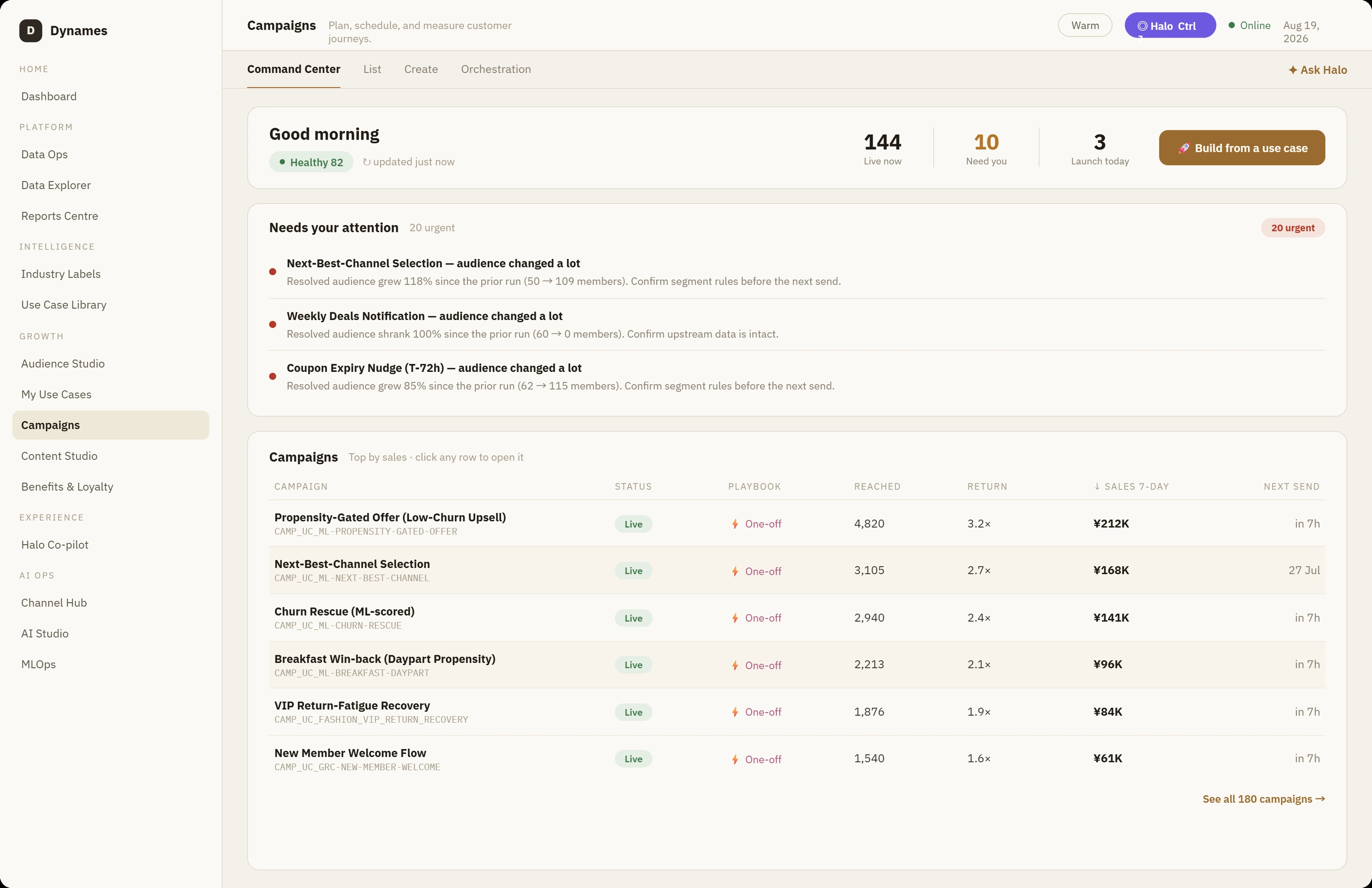
From campaigns to continuous decisions.
Proven in production.
One platform. Every customer decision.
A leading global quick-service restaurant brandAgent-native DYNAMES connects customer data, industry ontology, models, engagement strategy and activation in one always-on platform — coordinating personalised marketing decisions and execution automatically, 24/7.
Read the full case study
At the scale of hundreds of millions of customers, rule-based marketing becomes increasingly difficult to operate: audiences multiply, signals change constantly, and every campaign introduces more decisions around who to engage, when, where and with what message.
Agent-native DYNAMES brings customer data, industry ontology, labels, predictive models, engagement strategy and activation into one always-on platform. Instead of rebuilding audiences and campaign rules each time, DYNAMES continuously interprets customer signals, ranks opportunities and coordinates multiple engagement strategies automatically.
The result is a customer-engagement operation that can personalise at massive scale without adding the same level of manual workload — with models and automation supporting the preparation and execution of each next action, 24/7. This is consistent with the DYNAMES product model of reusable intelligence, continuous re-ranking and automated campaign orchestration rather than campaign-by-campaign rebuilding.
Proven use cases. Live in 2 weeks.
A leading quick-service restaurant brandDYNAMES reused proven restaurant engagement use cases, audience logic and predictive models — adapting them to the brand’s own data, channels and campaign rules instead of rebuilding from scratch.
Read the full case study
A new brand does not mean starting from zero. DYNAMES brought proven restaurant customer-engagement use cases, audience logic, labels and predictive models into a new data and channel environment — then adapted them to the brand’s own customers, campaign rules and operating needs.
That reusable foundation allowed the team to move from setup to live engagement in just 2 weeks, rather than rebuilding audience and campaign logic from scratch. From there, the programme expanded across lifecycle use cases including frequency growth, lapse prevention, first-to-second purchase conversion and customer win-back. These use cases were supported by reusable customer labels and predictive models and executed across multiple engagement channels.
This is the DYNAMES model: proven industry use cases are stored as reusable product assets, then adopted and customised for each new brand. Every deployment therefore starts with more intelligence already built in — shortening the path from data connection to live customer engagement.
DYNAMES FAQs
Can it send something nobody approved?
No. Every play is preset, and each one names its human gate before it can run. The only plays that send without a person in the loop are the ones your team has explicitly approved as needing no gate, such as an appointment reminder.
How does it handle consent and contact fatigue?
Consent state and frequency caps are properties of the audience, not a check at send time. A person who has opted out, or who has already been contacted up to the cap, is not in the cohort to begin with.
Do we have to learn a new campaign tool?
DYNAMES is operated in conversation: your team says what it wants in plain language and the workflow studio assembles the steps. Everything it builds stays visible and editable, so the conversation is a shortcut rather than a black box.
How do we know a play actually worked?
Each play carries its own KPIs and supports holdout groups, so you can separate the lift the play caused from what would have happened anyway. Results are reported per play rather than only in aggregate.
Which channels does it run?
Any channel you own — in-app, push, SMS, messaging, email and letter, sequenced within a play so a person is reached the cheapest and least intrusive way first, and escalated only if they do not respond.
How long does a deployment take?
Three to four weeks for a governed rollout, including the play library, the audience definitions, consent rules and approval paths. The sector pack arrives with the use cases and KPIs already encoded, which is what removes most of the setup.
Bring one journey you are running by hand
We map it to a preset play end to end — the trigger, the channel sequence, the consent rules and who has to approve what — then show you the rest of the pack for your sector.
info@quantumoo.ai